
Question 1
Which process is possible due to the fluidity of cell membranes?
A. Endocytosis
B. Osmosis
C. ATP production
D. Cell recognition
Medium
Mark as Complete
Mark Scheme
Question 2
What is the function of proteins in passive transport?
A. To serve as electron carriers in the membrane
B. To interact with hormones to influence cell activity
C. To serve as channels so that specific molecules diffuse across the membrane
D. To release energy from ATP so that specific substances can cross the membrane
Easy
Mark as Complete
Mark Scheme
Question 3
The cell membrane model proposed by Davson–Danielli was a phospholipid bilayer sandwiched between two layers of globular protein. Which evidence led to the acceptance of the Singer–Nicolson model?
A. The orientation of the hydrophilic phospholipid heads towards the proteins
B. The formation of a hydrophobic region on the surface of the membrane
C. The placement of integral and peripheral proteins in the membrane
D.The interactions due to amphipathic properties of phospholipids
Easy
Mark as Complete
Mark Scheme
Question 4
Animal cells often secrete glycoproteins as extracellular components. What is a role of these glycoproteins?
A. Adhesion.
B. Additional energy reserve.
C. Membrane fluidity.
D. Water uptake.
Easy
Mark as Complete
Mark Scheme
Question 5
A cell was placed into a solution containing a dye. After two hours the concentration of the dye inside the cell was higher than in the solution. This was repeated in the presence of a substance that inhibits ATP. In this case the dye did not enter the cell. What is the probable mechanism by which the dye entered the cell?
A. Active transport
B. Simple diffusion
C. Osmosis
D. Facilitated diffusion
Medium
Mark as Complete
Mark Scheme
Question 6
The diagram shows protein channels involved in the passive movement of a substance into the cell across the cell membrane.
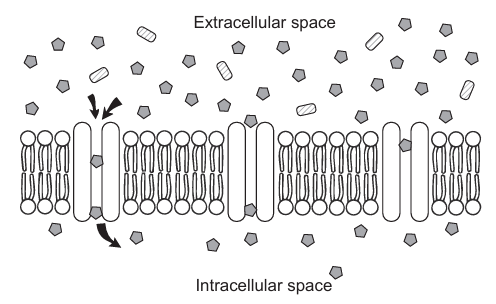
What describes this movement?
A. Energy of ATP is used to transport substances into the cell.
B. Substances can move from areas of low to areas of high concentration.
C. The proteins ensure that movement of substances is only in one direction.
D. Net movement occurs until the concentrations in and out of the cell are equal.
Medium
Mark as Complete
Mark Scheme
Question 7
What is the passive movement of particles, such as sodium ions from an area of higher concentration to an area of lower concentration through a protein carrier?
A. Diffusion
B. Osmosis
C. Facilitated diffusion
D. Active transport
Easy
Mark as Complete
Mark Scheme
Question 8
Which molecule regulates the fluidity of cell membranes?
A. Phospholipid
B. Cholesterol
C. Glycoprotein
D. Glycoprotein
Easy
Mark as Complete
Mark Scheme
Question 9
Outline four types of membrane transport, including their use of energy. [4]
Medium
Mark as Complete
Mark Scheme
Question 10
Discuss alternative models of membrane structure including evidence for or against each model. [8]
Medium
Mark as Complete
Mark Scheme
Question 1
Which process is possible due to the fluidity of cell membranes?
A. Endocytosis
B. Osmosis
C. ATP production
D. Cell recognition
Answer: A
A. Correct. The fluidity of the phospholipid bilayer allows the cell membrane to change shape and form vesicles, enabling endocytosis. Endocytosis involves the membrane folding inward to bring materials into the cell.
B. Correct. Incorrect. Osmosis is the passive movement of water molecules across a partially permeable membrane. Water is small enough to pass through the phospholipid bilayer. Although membrane fluidity is a property of the membrane, osmosis does not depend directly on large-scale shape changes such as vesicle formation.
C. Incorrect. ATP production (usually via cellular respiration or chemiosmosis) depends on proteins and enzymes in membranes, not directly on membrane fluidity.
D. Incorrect. Cell recognition is a function of glycoproteins and glycolipids on the outer surface of the plasma membrane. While the membrane is described as a fluid mosaic due to the movement of proteins and lipids, recognition itself is not a direct result of membrane fluidity.
Question 2
What is the function of proteins in passive transport?
A. To serve as electron carriers in the membrane
B. To interact with hormones to influence cell activity
C. To serve as channels so that specific molecules diffuse across the membrane
D. To release energy from ATP so that specific substances can cross the membrane
Answer: C
A. Incorrect. Electron carriers are involved in the electron transport chain for ATP production, not passive transport.
B. Incorrect. Hormone interaction is a function of receptor proteins, not passive transport proteins.
Membrane potential comes from ion gradients maintained by protein pumps and ion channels, not by lipids.
C. Correct. Passive transport includes facilitated diffusion, in which channel proteins (integral transmembrane proteins) provide hydrophilic channels for polar or charged particles to move down their concentration gradient. No ATP is required.
D.Incorrect. ATP use indicates active transport, not passive transport.
Question 3
The cell membrane model proposed by Davson–Danielli was a phospholipid bilayer sandwiched between two layers of globular protein. Which evidence led to the acceptance of the Singer–Nicolson model?
A. The orientation of the hydrophilic phospholipid heads towards the proteins
B. The formation of a hydrophobic region on the surface of the membrane
C. The placement of integral and peripheral proteins in the membrane
D.The interactions due to amphipathic properties of phospholipids
Answer: C
A. Incorrect. Hydrophilic heads face outward in both models; this does not distinguish them.
B. Incorrect. The hydrophobic region is in the centre of the bilayer, not on the surface.
C. Correct. Evidence from protein extraction and freeze-etching studies showed proteins embedded within or spanning the membrane, which contradicts the Davson–Danielli model and led to acceptance of the fluid-mosaic model.
D. Incorrect. Amphipathic phospholipids form bilayers in both models; this feature does not differentiate them.
Question 4
Animal cells often secrete glycoproteins as extracellular components. What is a role of these glycoproteins?
A. Adhesion.
B. Additional energy reserve.
C. Membrane fluidity.
D. Water uptake.
Answer: A
A. Correct. Many cells secrete glycoproteins outside the plasma membrane. These help cells adhere to one another, allowing them to form tissues and organs.
B. Incorrect. The main energy storage molecules mentioned are carbohydrates and lipids. Lipids are especially suited for long-term energy storage because they release twice as much energy per gram as carbohydrates. Although glycoproteins are composed of polypeptides and carbohydrates, their primary roles are structural and involved in recognition, not as major additional energy reserves.
C. Incorrect. The fluidity of the cell membrane is primarily regulated by cholesterol. Cholesterol is an essential component of the plasma membrane of all animal cells and acts as a modulator of membrane fluidity. In addition, the ratio of saturated to unsaturated fatty acids in the phospholipid bilayer also affects membrane fluidity.
D.Incorrect. Although glycoproteins and glycolipids, which make up the glycocalyx, are highly hydrophilic and attract a significant amount of water to the cell surface, helping the cell interact with its aqueous environment, their role is not to directly absorb water.
Question 5
A cell was placed into a solution containing a dye. After two hours the concentration of the dye inside the cell was higher than in the solution. This was repeated in the presence of a substance that inhibits ATP. In this case the dye did not enter the cell. What is the probable mechanism by which the dye entered the cell?
A. Active transport
B. Simple diffusion
C. Osmosis
D. Facilitated diffusion
Answer: A
A. Correct. Active transport moves particles from lower to higher concentration (against the gradient) using ATP. Pump proteins use ATP to move specific substances across the membrane.
B. Incorrect. Simple diffusion is passive and moves substances from high to low concentration without ATP.
C. Incorrect. Osmosis is the passive movement of water, not solutes such as dyes, and it is not inhibited by ATP.
D. Incorrect. Facilitated diffusion is passive, moves substances down the concentration gradient, and does not require ATP.
Question 6
The diagram shows protein channels involved in the passive movement of a substance into the cell across the cell membrane.
What describes this movement?
A. Energy of ATP is used to transport substances into the cell.
B. Substances can move from areas of low to areas of high concentration.
C. The proteins ensure that movement of substances is only in one direction.
D. Net movement occurs until the concentrations in and out of the cell are equal.
Answer: D
A. Incorrect. ATP is not used in passive transport. If ATP were used, it would be active transport, not the process shown.
B. Incorrect. Moving from low to high concentration requires energy (ATP). Meanwhile passive transport only moves high to low.
C. Incorrect. Channel proteins do not enforce one-way movement.
They simply allow diffusion to occur, and diffusion can go either direction depending on the concentration gradient.
D. Correct. The diagram shows passive movement through a protein channel → this is facilitated diffusion, which always moves down the concentration gradient until equilibrium.
Question 7
What is the passive movement of particles, such as sodium ions from an area of higher concentration to an area of lower concentration through a protein carrier?
A. Diffusion
B. Osmosis
C. Facilitated diffusion
D. Active transport
Answer: C
A. Incorrect. Although diffusion is movement from high to low concentration, simple diffusion occurs directly through the phospholipid bilayer. Ions such as sodium cannot pass easily through the bilayer because they are charged.
B. Incorrect. Osmosis refers only to the movement of water.
C. Correct. It is the passive movement of particles through transmembrane proteins (channel or carrier proteins). Charged particles and polar molecules require protein channels to diffuse.
D. Incorrect. Active transport requires ATP and moves substances against the concentration gradient.
Question 8
Which molecule regulates the fluidity of cell membranes?
A. Phospholipid
B. Cholesterol
C. Glycoprotein
D. Glycoprotein
Answer: B
A. Incorrect. Phospholipids form the basic structure of the membrane. While fatty acid composition can influence membrane fluidity, cholesterol is the primary regulator.
B. Correct. Cholesterol is found in the plasma membranes of animal cells and acts as a modulator of membrane fluidity. It stabilizes the membrane at high temperatures and prevents it from becoming too rigid at low temperatures.
C. Incorrect. Glycoproteins are proteins with carbohydrate groups, located on the outer surface of the membrane. Their functions include cell recognition and cell adhesion.
D. Incorrect. Peripheral proteins attach to the membrane surface and do not regulate membrane fluidity.
Question 9
Outline four types of membrane transport, including their use of energy. [4]
Any four of the following:
a. simple diffusion is passive movement of molecules/ions along a concentration gradient
b. facilitated diffusion is passive movement of molecules/ions along a concentration gradient through a protein channel «without use of energy»
c. osmosis is the passage of water through a membrane from lower solute concentration to higher
d. active transport is movement of molecules/ions against the concentration gradient «through membrane pumps» with the use of ATP/energy
e. endocytosis is the infolding of membrane/formation of vesicles to bring molecules into cell with use of energy OR exocytosis is the infolding of membrane/formation of vesicles to release molecules from cell with use of energy
f. chemiosmosis occurs when protons diffuse through ATP synthase «in membrane» to produce ATP
Sample answer:
Cells use several transport mechanisms to move substances across their membranes. Simple diffusion is a passive process in which molecules move down their concentration gradient without requiring energy [1]. Facilitated diffusion is also passive, but it relies on protein channels to help specific ions or molecules cross the membrane, again without using ATP [1]. Active transport, in contrast, requires energy from ATP to move substances against their concentration gradient through membrane pump proteins [1]. In addition, cells use endocytosis, an energy-dependent process in which the membrane folds inward to form vesicles that bring materials into the cell [1].
Question 10
Discuss alternative models of membrane structure including evidence for or against each model. [8]
Any eight of the following:
a. early evidence showed membranes are partially permeable AND organic solvents penetrate faster than water
b. suggests they have non-polar regions
c. chemical analysis showed membranes consist mainly of proteins and lipids
d. layer of phospholipids spread over water, orientate themselves into monolayer with nonpolar/hydrophobic tails out of water and polar/hydrophilic heads in water surface
e. when shaken with water form micelles/particles with tails inwards away from water
f. Davson–Danielli model proposed phospholipid bilayer coated with protein molecules on both surfaces
g. evidence from electron microscopy «supported Davson–Danielli model»
h. three-layered structure/ sandwich/railway tracks/two dark bands with a light band between
i. model could not account for hydrophobic proteins / artifacts due to low resolution
j. fluorescent labelling / freeze fracturing later used to investigate membrane structure
k. led to Singer-Nicholson / fluid mosaic model of protein molecules floating in fluid lipid bilayer
l. shows particles/proteins project partially and sometimes right through lipid bilayer
m. indicates peripheral and integral proteins present
Sample answer:
Models of membrane structure have evolved over time as new evidence and analytical methods emerged. Early chemical analyses showed that cell membranes are composed mainly of proteins and lipids [1]. Additional early evidence indicated that membranes are partially permeable and that organic solvents penetrate more quickly than water [1], suggesting the presence of non-polar regions [1]. Based on these findings, the Davson–Danielli model was proposed, in which a phospholipid bilayer is coated with layers of globular proteins on both surfaces [1]. Initial electron micrographs appeared to support this model, showing a trilaminar structure, two dark bands with a lighter band in between, resembling railway tracks [1]. However, over time the model was rejected because it could not account for the presence of hydrophobic proteins (and also due to artifacts caused by low resolution) [1]. As new techniques such as fluorescent tagging and freeze-fracture methods were developed, researchers gained clearer insights into membrane structure [1]. Freeze-fracture studies later demonstrated that particles/proteins protrude partially and sometimes span across the lipid bilayer. This new evidence directly contradicted the idea of a continuous protein layer on the membrane surface, leading to the development and widespread acceptance of the Singer–Nicolson fluid mosaic model, which describes proteins floating within a fluid lipid bilayer [1].
Question 1
Which process is possible due to the fluidity of cell membranes?
A. Endocytosis
B. Osmosis
C. ATP production
D. Cell recognition
Question 2
What is the function of proteins in passive transport?
A. To serve as electron carriers in the membrane
B. To interact with hormones to influence cell activity
C. To serve as channels so that specific molecules diffuse across the membrane
D. To release energy from ATP so that specific substances can cross the membrane
Question 3
The cell membrane model proposed by Davson–Danielli was a phospholipid bilayer sandwiched between two layers of globular protein. Which evidence led to the acceptance of the Singer–Nicolson model?
A. The orientation of the hydrophilic phospholipid heads towards the proteins
B. The formation of a hydrophobic region on the surface of the membrane
C. The placement of integral and peripheral proteins in the membrane
D.The interactions due to amphipathic properties of phospholipids
Question 4
Animal cells often secrete glycoproteins as extracellular components. What is a role of these glycoproteins?
A. Adhesion.
B. Additional energy reserve.
C. Membrane fluidity.
D. Water uptake.
Question 5
A cell was placed into a solution containing a dye. After two hours the concentration of the dye inside the cell was higher than in the solution. This was repeated in the presence of a substance that inhibits ATP. In this case the dye did not enter the cell. What is the probable mechanism by which the dye entered the cell?
A. Active transport
B. Simple diffusion
C. Osmosis
D. Facilitated diffusion
Question 6
The diagram shows protein channels involved in the passive movement of a substance into the cell across the cell membrane.
What describes this movement?
A. Energy of ATP is used to transport substances into the cell.
B. Substances can move from areas of low to areas of high concentration.
C. The proteins ensure that movement of substances is only in one direction.
D. Net movement occurs until the concentrations in and out of the cell are equal.
Question 7
What is the passive movement of particles, such as sodium ions from an area of higher concentration to an area of lower concentration through a protein carrier?
A. Diffusion
B. Osmosis
C. Facilitated diffusion
D. Active transport
Question 8
Which molecule regulates the fluidity of cell membranes?
A. Phospholipid
B. Cholesterol
C. Glycoprotein
D. Glycoprotein
Question 9
Outline four types of membrane transport, including their use of energy. [4]
Question 10
Discuss alternative models of membrane structure including evidence for or against each model. [8]

