
Question 1
Which level(s) of ecological complexity involve(s) biotic factors but not abiotic factors?
I. Community
II. Ecosystem
III. Population
A. I only
B. II only
C. I and II only
D. I and III only
Medium
Mark as Complete
Mark Scheme
Question 2
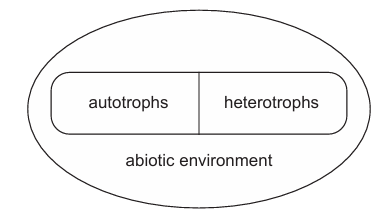
What is represented by everything inside the oval area in the diagram?
A. A community
B. An ecosystem
C. A food web
D. A habitat
Easy
Mark as Complete
Mark Scheme
Question 3
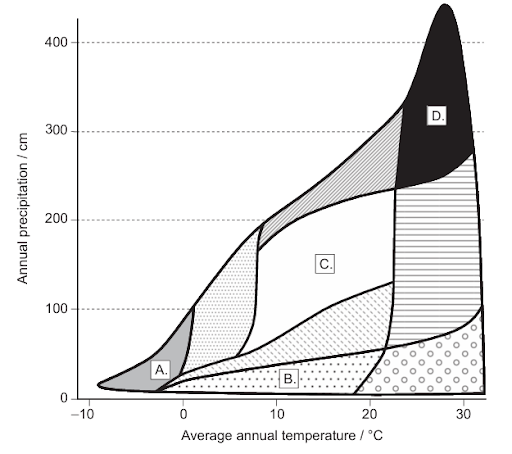
A graph of abiotic factors needed for biomes to develop is shown. Which label identifies temperate forest?
Easy
Mark as Complete
Mark Scheme
Question 4
Plankton are major producers in marine ecosystems. Only a small proportion of the energy harvested by plankton is passed to the primary consumers. Which process in phytoplankton results in the largest loss of energy that could otherwise be utilized by consumers?
A. Reproduction
B. Homeostasis
C. Excretion
D. Respiration
Easy
Mark as Complete
Mark Scheme
Question 5
Which of the following ecological units includes abiotic factors?
A. A community
B. An ecosystem
C. A population
D. A trophic level
Medium
Mark as Complete
Mark Scheme
Question 6
What is an abiotic factor in an ecosystem?
A. The mutualistic relationship between zooxanthellae and coral.
B. The predator–prey relationship between wolves and elk.
C. The salinity surrounding marram grass on a sand dune.
D. An infectious disease affecting a population of rabbits.
Medium
Mark as Complete
Mark Scheme
Question 7
Outline a method used to correlate the distribution of plant species with an abiotic factor? [2]
Medium
Mark as Complete
Mark Scheme
Question 8
List two abiotic factors that affect the distribution of plant species. [1]
Medium
Mark as Complete
Mark Scheme
Question 9
State the name of the biome in which there is little precipitation and temperatures are very low. [1]
Medium
Mark as Complete
Mark Scheme
Question 10
Native oyster populations are decreasing where rivers meet the ocean along the northwest coast of North America. These oyster populations are being attacked by a gastropod.
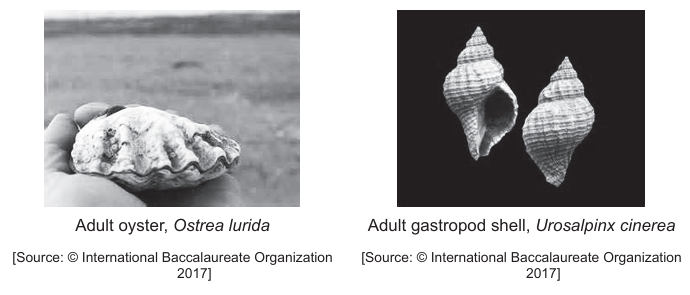
It is known that oysters and gastropods have hard parts composed of calcium carbonate and that ocean acidification is increasing. Studies were carried out using juvenile oysters and gastropods to investigate the effects of acidification on the decrease in the population of oysters.
The first step was to raise oysters in two different mesocosms. One had seawater at a normal concentration of CO2 and the other had sea water with a high concentration of CO2. Gastropods were raised in two further mesocosms with normal and high CO2 concentrations respectively.
Outline how acidified sea water could affect the shells of the oyster.
Medium
Mark as Complete
Mark Scheme
Question 1
Which level(s) of ecological complexity involve(s) biotic factors but not abiotic factors?
I. Community
II. Ecosystem
III. Population
A. I only
B. II only
C. I and II only
D. I and III only
Answer: D
I. Correct. A community includes all living organisms, forming the biotic component of an ecosystem. The definition focuses on species and their interactions (biotic factors), not on abiotic factors.
II. Incorrect. An ecosystem is defined as a biological community and the surrounding environment in which they live and interact. An ecosystem includes both biotic and abiotic components; therefore it involves abiotic factors.
III. Correct. A population is a group of individuals of the same species living and interacting in an area. Although the size and distribution of a population may be affected by abiotic factors (e.g., temperature, rainfall), the population itself is defined solely by biotic factors (organisms of the same species).
Therefore D is correct.
A, B, and C are incorrect.
Question 2
What is represented by everything inside the oval area in the diagram?
A. A community
B. An ecosystem
C. A food web
D. A habitat
Answer: B
A. Incorrect. A community includes only the living organisms (autotrophs + heterotrophs). It does not include abiotic factors, but the diagram does.
B. Correct. An ecosystem includes both:
C. Incorrect. A food web shows feeding relationships. The diagram does not show energy flow or feeding links, just organism types and abiotic factors.
D. Incorrect. A habitat is the physical place an organism lives. The diagram includes entire groups of organisms and abiotic factors, not a specific habitat.
Question 3
A graph of abiotic factors needed for biomes to develop is shown. Which label identifies temperate forest?
Answer: C
The temperate forest biome typically develops under:
A. Incorrect. A is cold with low precipitation → tundra.
B. Incorrect. B is warm with low precipitation → desert.
C. Correct. C is a moderate temperature and moderate precipitation → temperate forest.
D. Incorrect. D is high temperature and very high precipitation → tropical rainforest.
Question 4
Plankton are major producers in marine ecosystems. Only a small proportion of the energy harvested by plankton is passed to the primary consumers. Which process in phytoplankton results in the largest loss of energy that could otherwise be utilized by consumers?
A. Reproduction
B. Homeostasis
C. Excretion
D. Respiration
Answer: D
A, B, and C are incorrect. Although reproduction, homeostasis, and excretion require energy, they do not account for the largest energy loss. The majority is lost as heat through respiration.
D. Correct. Cellular respiration uses up most of the chemical energy stored by autotrophs (including phytoplankton). Much of this energy is converted to heat and lost to the environment, making it unavailable to the next trophic level.
Question 5
Which of the following ecological units includes abiotic factors?
A. A community
B. An ecosystem
C. A population
D. A trophic level
Answer: B
A. Incorrect A community consists of different populations living and interacting in an area, only biotic components.
B. Correct. An ecosystem includes a community and its abiotic environment. Abiotic factors (such as climate and soil) are key components of an ecosystem.
C. Incorrect. A population is a group of individuals of the same species, entirely biotic.
D. Incorrect. A trophic level refers to feeding positions in a food chain, involving living organisms (biotic factors).
Question 6
What is an abiotic factor in an ecosystem?
A. The mutualistic relationship between zooxanthellae and coral.
B. The predator–prey relationship between wolves and elk.
C. The salinity surrounding marram grass on a sand dune.
D. An infectious disease affecting a population of rabbits.
Answer: C
A. Incorrect This is a biotic relationship, specifically symbiosis or mutualism, in which both species benefit. Zooxanthellae and corals are two living organisms interacting with each other. Biotic factors include interactions between living organisms, such as competition or predation.
B. Incorrect. Predation is a biological interaction in which one organism (the predator) kills and eats another organism (the prey). The predator–prey relationship (e.g., wolves and elk) is a biotic factor that limits population growth.
C. Correct. Salinity is an example of an abiotic (non-living, physical) factor that can influence an organism or an ecosystem. Marram grass lives in coastal sand dune environments and must adapt to survive in dry conditions with high salinity.
D. Incorrect. Infectious diseases are caused by pathogens. Pathogenicity is the ability of microorganisms to harm a host and lead to disease. Pathogens (microbes) are living organisms; therefore, disease and pathogenicity are classified as biotic factors in interspecies interactions. Biotic, density-dependent factors include the transmission of pathogens or parasites in dense populations.
Question 7
Outline a method used to correlate the distribution of plant species with an abiotic factor? [2]
Any two of the following:
a. transect used when there is a transition in habitats and populations;
b. description of use of a line or belt transect;
c. height variation/light intensity/salinity/various abiotic factors can be recorded;
d. along the transect, along with sampling of plant species present;
Sample answer:
A suitable method for correlating the distribution of plant species with an abiotic factor is to use a line or belt transect [1] across an area where habitat conditions change. The transect is laid out through the environment, and at regular intervals along this line, both the plant species present and the chosen abiotic factor such as light intensity or salinity [1] are recorded. By comparing how plant abundance or presence varies with the measured abiotic factor along the transect, patterns can be identified that show how the abiotic condition influences plant distribution.
Question 8
List two abiotic factors that affect the distribution of plant species. [1]
Any two of the following:
temperature / water / light / soil pH / salinity / mineral nutrients.
Award [1] for any two abiotic factors.
Sample answer:
Two abiotic factors that affect the distribution of plant species are temperature and light [1] . Temperature is an abiotic limiting factor that influences the rate of enzyme reactions in the cells of all organisms. The distribution of plants is also affected by light intensity, which is one of the main limiting factors influencing the rate of photosynthesis and primary productivity.
Question 9
State the name of the biome in which there is little precipitation and temperatures are very low. [1]
tundra
Sample answer:
The biome with low precipitation and very low temperatures is the tundra [1]. The tundra ecosystem is characterized by low temperatures with little rainfall and a very low annual average temperature. Tundra ecosystems frequently have temperatures below 0 °C and extremely dry weather. The tundra is an extremely harsh environment, with very low temperatures and low precipitation.
Question 10
Native oyster populations are decreasing where rivers meet the ocean along the northwest coast of North America. These oyster populations are being attacked by a gastropod.
It is known that oysters and gastropods have hard parts composed of calcium carbonate and that ocean acidification is increasing. Studies were carried out using juvenile oysters and gastropods to investigate the effects of acidification on the decrease in the population of oysters.
The first step was to raise oysters in two different mesocosms. One had seawater at a normal concentration of CO2 and the other had sea water with a high concentration of CO2. Gastropods were raised in two further mesocosms with normal and high CO2 concentrations respectively.
Outline how acidified sea water could affect the shells of the oyster.
Any one of the following:
shells might dissolve/deteriorate / become smaller/thinner/weaker / OWTTE
OR
shell formation reduced / more difficult
Sample answer:
Acidified seawater can reduce the ability of oysters to form their shells [1], because their shells are made of calcium carbonate. When pH decreases, calcification becomes more difficult, so the shells may become thinner and weaker over time. In more acidic conditions, the calcium carbonate in the shell can even begin to dissolve, leading to deterioration of the oyster’s shell structure.
Question 1
Which level(s) of ecological complexity involve(s) biotic factors but not abiotic factors?
I. Community
II. Ecosystem
III. Population
A. I only
B. II only
C. I and II only
D. I and III only
Question 2
What is represented by everything inside the oval area in the diagram?
A. A community
B. An ecosystem
C. A food web
D. A habitat
Question 3
A graph of abiotic factors needed for biomes to develop is shown. Which label identifies temperate forest?
Question 4
Plankton are major producers in marine ecosystems. Only a small proportion of the energy harvested by plankton is passed to the primary consumers. Which process in phytoplankton results in the largest loss of energy that could otherwise be utilized by consumers?
A. Reproduction
B. Homeostasis
C. Excretion
D. Respiration
Question 5
Which of the following ecological units includes abiotic factors?
A. A community
B. An ecosystem
C. A population
D. A trophic level
Question 6
What is an abiotic factor in an ecosystem?
A. The mutualistic relationship between zooxanthellae and coral.
B. The predator–prey relationship between wolves and elk.
C. The salinity surrounding marram grass on a sand dune.
D. An infectious disease affecting a population of rabbits.
Question 7
Outline a method used to correlate the distribution of plant species with an abiotic factor? [2]
Question 8
List two abiotic factors that affect the distribution of plant species. [1]
Question 9
State the name of the biome in which there is little precipitation and temperatures are very low. [1]
Question 10
Native oyster populations are decreasing where rivers meet the ocean along the northwest coast of North America. These oyster populations are being attacked by a gastropod.
It is known that oysters and gastropods have hard parts composed of calcium carbonate and that ocean acidification is increasing. Studies were carried out using juvenile oysters and gastropods to investigate the effects of acidification on the decrease in the population of oysters.
The first step was to raise oysters in two different mesocosms. One had seawater at a normal concentration of CO2 and the other had sea water with a high concentration of CO2. Gastropods were raised in two further mesocosms with normal and high CO2 concentrations respectively.
Outline how acidified sea water could affect the shells of the oyster.

