
Question 1
What prevents plants from converting carbon dioxide into glucose in the dark?
A. They do not have a source of energy.
B. It is too cold.
C. They do not require glucose during the night.
D. Their enzymes are inhibited.
Easy
Mark as Complete
Mark Scheme
Question 2
The graph shows the absorption spectra of chlorophyll a and chlorophyll b.
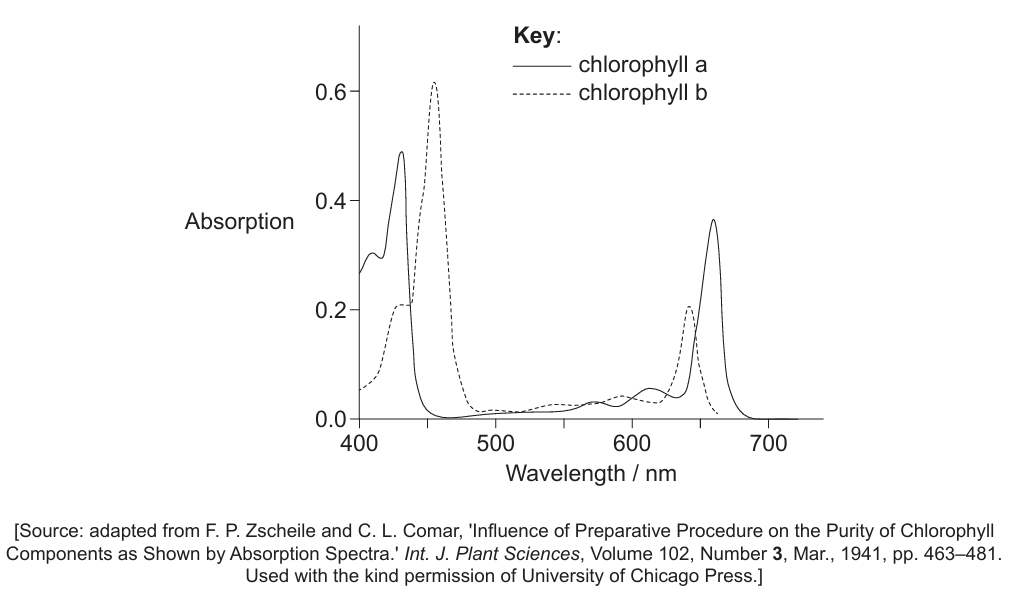
What can be concluded from the graph?
A. Both chlorophyll a and chlorophyll b absorb a large amount of green light
B. Chlorophyll b absorbs red light more efficiently than blue light
C. Other pigments must absorb light between blue and red in the spectrum
D. Chlorophyll a and chlorophyll b have different absorption peaks
Easy
Mark as Complete
Mark Scheme
Question 3
A photosynthesis experiment was carried out using an aquatic plant. The image shows the contents of the test tube after being exposed to light and room temperature for 30 minutes.
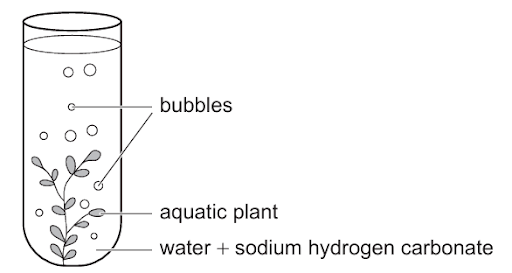
What explains the presence of bubbles?
A. Oxygen is formed when carbon dioxide combines with chlorophyll.
B. Carbon dioxide is formed during the light-dependent reaction.
C. Oxygen is released when light splits water molecules in chloroplasts.
D. Carbon dioxide is released from dissociation of sodium hydrogen carbonate.
Easy
Mark as Complete
Mark Scheme
Question 4
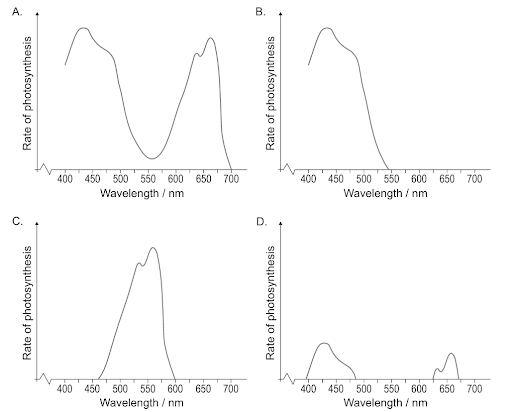
Which graph represents the action spectrum for a green plant receiving only blue light?
Easy
Mark as Complete
Mark Scheme
Question 5
Which of the following is a role of ATP in photosynthesis?
A. It provides the energy to make carbohydrate molecules.
B. It splits water molecules to form oxygen and hydrogen.
C. It breaks down pyruvate into carbon dioxide.
D. It converts light energy into chemical energy.
Easy
Mark as Complete
Mark Scheme
Question 6
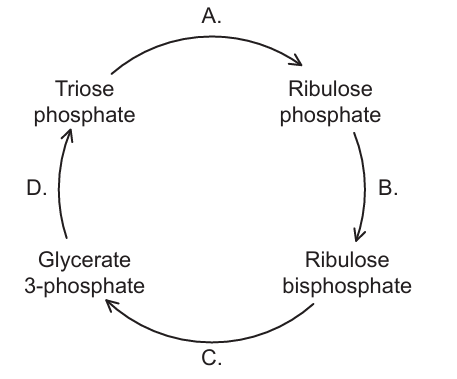
The diagram shows some of the intermediate compounds produced during the Calvin cycle. At what stage does carboxylation take place?
Easy
Mark as Complete
Mark Scheme
Question 7
The diagram shows a section through a thylakoid. Electrons move from X to Y.
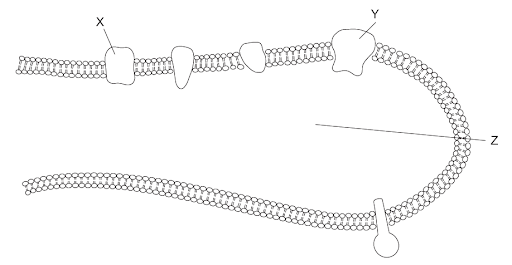
What do the letters X, Y and Z represent?
| X | Y | Z | |
| A. | photosystem I | photosystem II | thylakoid space |
| B. | photosystem II | photosystem I | thylakoid space |
| C. | ATP synthase | photosystem II | stroma |
| D. | photosystem II | ATP synthase | stroma |
Easy
Mark as Complete
Mark Scheme
Question 8
What occurs in the light-independent reactions of photosynthesis?
A. Glycerate 3-phosphate is reduced to triose phosphate.
B. Ribulose bisphosphate is regenerated using reduced NADP
C. Ribulose bisphosphate is oxidized to two molecules of glycerate 3-phosphate.
D. Both ATP and NADP are used to produce triose phosphate.
Easy
Mark as Complete
Mark Scheme
Question 9
Describe how ATP is produced by Photosystem II in the light-dependent stage of photosynthesis. [5]
Hard
Mark as Complete
Mark Scheme
Question 10
Describe how leaf cells make use of light energy. [5]
Hard
Mark as Complete
Mark Scheme
Question 1
What prevents plants from converting carbon dioxide into glucose in the dark?
A. They do not have a source of energy.
B. It is too cold.
C. They do not require glucose during the night.
D. Their enzymes are inhibited.
Answer: A
A. Correct: The conversion of carbon dioxide (CO₂) into glucose occurs in the light-independent stage (Calvin cycle) of photosynthesis. Even though this stage does not directly require light, it depends on ATP and reduced NADP (NADPH) - both of which are produced during the light-dependent reactions. In the dark, light-dependent reactions stop, so no ATP or NADPH are generated. Without these energy sources, the Calvin cycle cannot proceed, and CO₂ cannot be fixed into glucose. Therefore, plants cannot convert CO₂ into glucose in the dark because they lack the energy (ATP and NADPH) needed for the process.
B. Incorrect: Temperature affects enzyme activity, but the inability to produce glucose at night is not due to low temperature. In the dark, even if the temperature is optimal, photosynthesis cannot occur because of no light energy to make ATP and NADPH.
C. Incorrect: Plants still need glucose at night for respiration to produce energy (ATP) for growth and maintenance. The problem is not the lack of need but the lack of energy supply to make glucose.
D. Incorrect: The Calvin cycle enzymes are not inhibited in darkness; they simply lack the substrates (ATP and NADPH) needed to function. Enzymes remain available, but the reaction cannot proceed without energy.
Question 2
The graph shows the absorption spectra of chlorophyll a and chlorophyll b.
What can be concluded from the graph?
A. Both chlorophyll a and chlorophyll b absorb a large amount of green light
B. Chlorophyll b absorbs red light more efficiently than blue light
C. Other pigments must absorb light between blue and red in the spectrum
D. Chlorophyll a and chlorophyll b have different absorption peaks
Answer: D
A. Incorrect: both pigments show very low absorption around 500-600 nm, which corresponds to green light. This is why plants appear green - green light is reflected, not absorbed.
B. Incorrect: The graph shows chlorophyll b absorbs more strongly in the blue region (around 455 nm) than in the red region (around 640 nm). So, blue light absorption > red light absorption for chlorophyll b.
C. Incorrect: the question asks for what can be concluded from this graph only. The graph only shows chlorophyll a and b - it does not provide data about other pigments like carotenoids or xanthophylls. While true in general biology, it cannot be concluded directly from this graph.
D. Correct: The graph shows absorption spectra for chlorophyll a (solid line) and chlorophyll b (dashed line). Both pigments absorb light strongly in the blue-violet (around 430-450 nm) and red (around 640-680 nm) regions, but their absorption peaks occur at slightly different wavelengths. Chlorophyll peaks at about 430 nm (blue) and 665 nm (red). Chlorophyll b peaks at about 455 nm (blue) and 640 nm (red). This difference means chlorophyll a and b absorb light at different specific wavelengths, allowing plants to capture a broader range of the light spectrum for photosynthesis.
Question 3
A photosynthesis experiment was carried out using an aquatic plant. The image shows the contents of the test tube after being exposed to light and room temperature for 30 minutes.
What explains the presence of bubbles?
A. Oxygen is formed when carbon dioxide combines with chlorophyll.
B. Carbon dioxide is formed during the light-dependent reaction.
C. Oxygen is released when light splits water molecules in chloroplasts.
D. Carbon dioxide is released from dissociation of sodium hydrogen carbonate.
Answer: C
A. Incorrect: chlorophyll does not combine with carbon dioxide. Chlorophyll only absorbs light energy - it does not chemically react with CO2. Oxygen is produced from water molecules, not from carbon dioxide.
B. Incorrect: the light-dependent reaction uses water and produces oxygen, ATP, and NADPH - it does not produce CO2. In fact, CO2 is used, not formed, in the light-independent (Calvin) cycle.
C. Correct: During photosynthesis, in the light-dependent reactions (occurring in the thylakoid membranes of chloroplasts), light energy is absorbed by chlorophyll. This energy is used to split water molecules (H2O) - a process called photolysis. The reaction is: 2H2O → 4H+ + 4e- + O2 . The oxygen gas (O2) produced is released as a byproduct, which appears as bubbles on the leaves or stem of the aquatic plant. The bubbles in the experiment are therefore oxygen formed from the splitting of water molecules by light.
D. Incorrect: Although sodium hydrogen carbonate provides a source of dissolved CO2 for the plant, the bubbles observed here are oxygen, not carbon dioxide. The CO2 from the solution dissolves, it does not appear as visible bubbles during photosynthesis.
Question 4
Which graph represents the action spectrum for a green plant receiving only blue light?
Answer: B
A. Incorrect: This graph shows two peaks, one around 450 nm (blue light) and another around 680 nm (red light). This represents the full action spectrum of photosynthesis under white light (which contains all wavelengths), not only blue light. Therefore, it’s not correct for a plant receiving only blue light.
B. Correct: Blue light has wavelengths between approximately 450-500 nm. Chlorophyll absorbs blue light very efficiently, which drives a high rate of photosynthesis at these wavelengths. When a green plant receives only blue light, photosynthesis occurs mostly in that region (around 450 nm) and drops sharply for other wavelengths, because no red or green light is available. Therefore, graph B is correct because it shows a single high peak in the blue region (around 450 nm) and no photosynthetic activity at other wavelengths.
C. Incorrect: This graph shows a single peak around 550 nm (green light), where chlorophyll absorbs very little light. Green light is mostly reflected, not absorbed, so photosynthesis is low in this region. Thus, the graph does not represent blue light conditions.
D. Incorrect: This graph shows small peaks in both the blue and red regions but with low intensity, suggesting limited absorption across both. That doesn’t match a situation where only blue light is provided, which should show a strong single peak in the blue region. Hence, graph D is incorrect.
Question 5
Which of the following is a role of ATP in photosynthesis?
A. It provides the energy to make carbohydrate molecules.
B. It splits water molecules to form oxygen and hydrogen.
C. It breaks down pyruvate into carbon dioxide.
D. It converts light energy into chemical energy.
Answer: A
A. Correct: ATP (adenosine triphosphate) is produced during the light-dependent reactions of photosynthesis. Its role is in the light-independent reactions (Calvin cycle), where it provides the energy needed for chemical reactions that: convert carbon dioxide (CO₂) into carbohydrates (e.g., glucose); regenerate ribulose bisphosphate (RuBP), the CO₂ acceptor molecule. So, ATP supplies the energy that drives the synthesis of organic molecules (like triose phosphate), which are later converted into carbohydrates.
B. Incorrect: Water splitting (photolysis) occurs in the light-dependent reactions, but it is driven by light energy absorbed by chlorophyll, not by ATP. The energy for splitting water comes directly from light, not from ATP.
C. Incorrect: This process happens during cellular respiration, specifically in the link reaction and Krebs cycle, not in photosynthesis. Photosynthesis builds up carbohydrates, while respiration breaks them down.
D. Incorrect: Light energy is converted to make ATP; ATP itself doesn’t do this.
Question 6
The diagram shows some of the intermediate compounds produced during the Calvin cycle. At what stage does carboxylation take place?
Answer: C
A. Incorrect: This step involves the regeneration of ribulose phosphate from triose phosphate using ATP. No CO₂ is added here - it’s an energy-driven rearrangement, not carboxylation.
B. Incorrect: This step uses ATP to convert ribulose phosphate into ribulose bisphosphate. No CO₂ is added; it’s an energy-dependent phosphorylation step.
C. Correct: Carboxylation is the process of adding carbon dioxide (CO₂) to another molecule. In the Calvin cycle, this occurs when carbon dioxide reacts with ribulose bisphosphate (RuBP). The enzyme RuBisCO (ribulose bisphosphate carboxylase/oxygenase) catalyzes this reaction: RuBP 5C+CO2 1C RuBisCO→ 2glycerate 3 -phosphate . Therefore, carboxylation takes place at stage C, where RuBP is converted to glycerate 3-phosphate.
D. Incorrect: This step uses ATP and NADPH (from light-dependent reactions) to reduce glycerate 3-phosphate into triose phosphate. It’s called the reduction phase, not carboxylation.
Question 7
The diagram shows a section through a thylakoid. Electrons move from X to Y.
What do the letters X, Y and Z represent?
| X | Y | Z | |
| A. | photosystem I | photosystem II | thylakoid space |
| B. | photosystem II | photosystem I | thylakoid space |
| C. | ATP synthase | photosystem II | stroma |
| D. | photosystem II | ATP synthase | stroma |
Answer: B
A. Incorrect: This reverses the real electron flow. Electrons do not move from PSI to PSII; they always move from PSII to PSI. So, this option is wrong even though “thylakoid space” for Z is correct.
B. Correct: Electrons move from X to Y. In the light-dependent reactions of photosynthesis, electrons flow from Photosystem II (PSII) 🡪 electron transport chain 🡪 Photosystem I (PSI). Therefore, X must be PSII (the source of excited electrons) and Y must be PSI (which receives those electrons). Z is labeled inside the thylakoid membrane. The region enclosed by the thylakoid membrane is the thylakoid space (lumen). This space accumulates protons (H⁺) during the light-dependent reactions, creating the proton gradient used to make ATP. Hence, B matches both the direction of electron flow and the correct location of Z.
C. Incorrect: ATP synthase is not the first step where electrons move; it’s involved in ATP production using protons, not in electron transfer. Also, electrons don’t move from ATP synthase to PSII. Incorrect on both components.
D. Incorrect: Electrons don’t move directly from PSII to ATP synthase. ATP synthase uses the proton gradient, not electrons, to produce ATP. Z = stroma is the correct location for proton movement out of the thylakoid, but the electron flow here is wrong.
Question 8
What occurs in the light-independent reactions of photosynthesis?
A. Glycerate 3-phosphate is reduced to triose phosphate.
B. Ribulose bisphosphate is regenerated using reduced NADP
C. Ribulose bisphosphate is oxidized to two molecules of glycerate 3-phosphate.
D. Both ATP and NADP are used to produce triose phosphate.
Answer: A
A. Correct: In the light-independent reactions (Calvin cycle), glycerate 3-phosphate is reduced to triose phosphate. This reduction uses ATP (as an energy source) and reduced NADP (as a hydrogen/electron donor), both of which are produced in the light-dependent reactions. Therefore, A is correct because it accurately describes the key reduction step of the Calvin cycle.
B. Incorrect: Ribulose bisphosphate (RuBP) is regenerated using ATP, not reduced NADP. Reduced NADP is used earlier in the cycle to reduce glycerate 3-phosphate to triose phosphate, not for RuBP regeneration.
C. Incorrect: RuBP is not oxidized; it is carboxylated (combined with CO₂) by the enzyme RuBisCO to form two molecules of glycerate 3-phosphate. No oxidation of RuBP occurs in this step.
D. Incorrect: NADP (oxidized form) is not used; it is reduced NADP (NADPH) that provides the reducing power. The statement would be correct if it said “ATP and reduced NADP (NADPH)” instead of “NADP”.
Question 9
Describe how ATP is produced by Photosystem II in the light-dependent stage of photosynthesis. [5]
Any five of the following:
a. light (energy) absorbed by pigments/chlorophyll/photosystems;
b. excited electrons passed to electron carriers/electron transport chain;
c. protons/hydrogen ions pumped into thylakoid (space);
d. proton gradient/high proton concentration generated;
e. protons pass via ATP synthase to the stroma;
f. ATP synthase phosphorylates ADP/ATP synthase converts ADP to ATP;
g. photophosphorylation/chemiosmosis;
h. ATP synthase/electron carriers/proton pumps/photosystems/pigment are in the thylakoid membrane;
Sample answer:
In Photosystem II during the light-dependent stage of photosynthesis, light energy is absorbed by pigments such as chlorophyll [1], exciting electrons to a higher energy level. These excited electrons are passed along a chain of electron carriers in the thylakoid membrane, forming an electron transport chain [1]. As the electrons move, protons (hydrogen ions) are pumped into the thylakoid space, creating a high concentration of protons inside [2]. This establishes a proton gradient across the thylakoid membrane. The protons then flow back into the stroma through ATP synthase [1], and the energy from this flow drives the conversion of ADP to ATP in a process known as chemiosmosis or photophosphorylation [1]. All the components involved - photosystems, electron carriers, proton pumps, and ATP synthase - are located in the thylakoid membrane [1].
Question 10
Describe how leaf cells make use of light energy. [5]
Any five of the following:
a. leaf cells contain chloroplasts;
b. light is absorbed by chlorophyll (in chloroplasts);
c. other pigments absorb different wavelengths;
d. light energy is used in photosynthesis;
e. (light is needed) to combine water and carbon dioxide/fix carbon dioxide;
f. carbon compounds/organic compounds/glucose/starch/carbohydrate are produced;
g.blue and red light is absorbed;
h. perform photolysis OR split water molecules;
Sample answer:
Leaf cells make use of light energy through the process of photosynthesis. They contain chloroplasts [1], which hold chlorophyll and other pigments that absorb light energy, mainly from blue and red wavelengths [2]. The chlorophyll absorbs this light energy, which is then used to drive photosynthesis [1]. During this process, light energy is used to split water molecules (photolysis) and to combine carbon dioxide and water to form organic compounds such as glucose or starch [2]. These carbon compounds store the energy originally captured from light, allowing the plant to use it later for growth and metabolism.
Question 1
What prevents plants from converting carbon dioxide into glucose in the dark?
A. They do not have a source of energy.
B. It is too cold.
C. They do not require glucose during the night.
D. Their enzymes are inhibited.
Question 2
The graph shows the absorption spectra of chlorophyll a and chlorophyll b.
What can be concluded from the graph?
A. Both chlorophyll a and chlorophyll b absorb a large amount of green light
B. Chlorophyll b absorbs red light more efficiently than blue light
C. Other pigments must absorb light between blue and red in the spectrum
D. Chlorophyll a and chlorophyll b have different absorption peaks
Question 3
A photosynthesis experiment was carried out using an aquatic plant. The image shows the contents of the test tube after being exposed to light and room temperature for 30 minutes.
What explains the presence of bubbles?
A. Oxygen is formed when carbon dioxide combines with chlorophyll.
B. Carbon dioxide is formed during the light-dependent reaction.
C. Oxygen is released when light splits water molecules in chloroplasts.
D. Carbon dioxide is released from dissociation of sodium hydrogen carbonate.
Question 4
Which graph represents the action spectrum for a green plant receiving only blue light?
Question 5
Which of the following is a role of ATP in photosynthesis?
A. It provides the energy to make carbohydrate molecules.
B. It splits water molecules to form oxygen and hydrogen.
C. It breaks down pyruvate into carbon dioxide.
D. It converts light energy into chemical energy.
Question 6
The diagram shows some of the intermediate compounds produced during the Calvin cycle. At what stage does carboxylation take place?
Question 7
The diagram shows a section through a thylakoid. Electrons move from X to Y.
What do the letters X, Y and Z represent?
| X | Y | Z | |
| A. | photosystem I | photosystem II | thylakoid space |
| B. | photosystem II | photosystem I | thylakoid space |
| C. | ATP synthase | photosystem II | stroma |
| D. | photosystem II | ATP synthase | stroma |
Question 8
What occurs in the light-independent reactions of photosynthesis?
A. Glycerate 3-phosphate is reduced to triose phosphate.
B. Ribulose bisphosphate is regenerated using reduced NADP
C. Ribulose bisphosphate is oxidized to two molecules of glycerate 3-phosphate.
D. Both ATP and NADP are used to produce triose phosphate.
Question 9
Describe how ATP is produced by Photosystem II in the light-dependent stage of photosynthesis. [5]
Question 10
Describe how leaf cells make use of light energy. [5]

