
Question 1
Azithromycin is an antibiotic commonly used to treat pneumonia, an infection of the lungs caused by Streptococcus pneumoniae. A patient was diagnosed for the second time with pneumonia, but the same antibiotic was ineffective this time. What biological explanation might there be for this?
A. S. pneumoniae had mutated.
B. S. pneumoniae had developed antibodies for the antibiotic.
C. The patient was immune to the antibiotic.
D. The patient had antibiotic remaining from the first treatment.
Easy
Mark as Complete
Mark Scheme
Question 2
The diagram shows stages in an immune response.
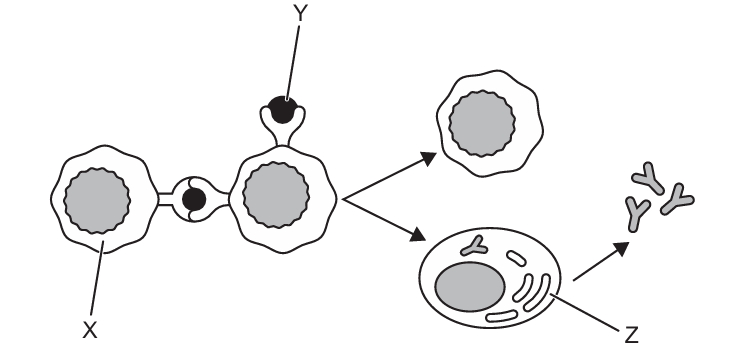
What is represented by labels X, Y and Z?
| X | Y | Z | |
| A. | helper T-cell | antibody | plasma cell |
| B. | B-cell | antigen | memory B-cell |
| C. | helper T-cell | antigen | plasma cell |
| D. | B-cell | antibody | memory B-cell |
Easy
Mark as Complete
Mark Scheme
Question 3
A cut in the skin triggers a cascade of reactions controlled by several blood components that results in the quick formation of a clot.
In which order do these blood components act to form a blood clot?
A. platelets – clotting factors – thrombin – fibrinogen – fibrin
B. platelets – fibrinogen – fibrin – thrombin – clotting factors
C. clotting factors – platelets – thrombin – fibrinogen – fibrin
D. clotting factors – platelets – thrombin – fibrin – fibrinogen
Easy
Mark as Complete
Mark Scheme
Question 4
What property of antibiotics makes them effective in the treatment of infectious diseases?
A. They stimulate the production of antibodies.
B. They block metabolic pathways in prokaryotes.
C. They block the metabolic processes in viruses.
D. They inhibit mitosis in eukaryotes.
Easy
Mark as Complete
Mark Scheme
Question 5
The graph shows changes in the relative amount of one blood component and the number of HIV RNA copies in blood plasma of an infected person over time.
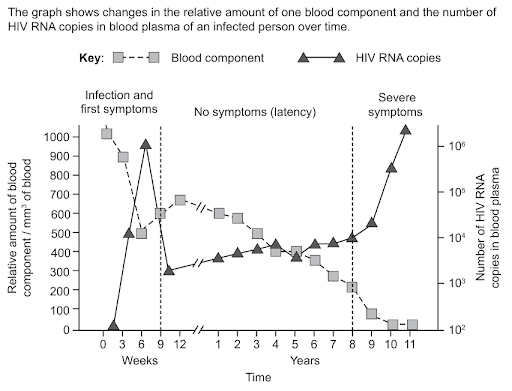
Which statement explains a likely symptom nine years after the initial infection?
A. The patient feels tired, as there would be fewer red blood cells to transport oxygen.
B. The patient has difficulty recovering from infectious diseases due to a lack of antibodies.
C. The risk of bleeding and blood infections increases due to a lack of clotting factors.
D. Opportunistic infections spread, as there are few phagocytes to destroy bacteria.
Easy
Mark as Complete
Mark Scheme
Question 6
The body has developed various methods to fight against infectious disease.
I. Fibrinogen is converted to fibrin, which prevents the entry of bacteria and loss of blood.
II. Phagocytic white blood cells recognize pathogens and ingest and destroy them.
III. Lymphocytes produce antibodies in response to pathogens in the blood.
Which provides specific immunity to disease?
A. I and II only
B. II and III only
C. I, II and III
D. III only
Easy
Mark as Complete
Mark Scheme
Question 7
What is a method of transmission of HIV and its effect on the immune system?
| Method of transmission | Effect on the immune system | |
| A. | Breastfeeding | Decrease in number of active lymphocytes |
| B. | Blood transfusion | Overall, a general increase in antibody production |
| C. | Waterborne | Overall, a general reduction in antibody production |
| D. | Mosquito bites | Increase in number of active lymphocytes |
Easy
Mark as Complete
Mark Scheme
Question 8
What is a feature of phagocytic white blood cells?
A. Stimulate blood clotting
B. Found only in the circulatory system
C. Form part of non-specific immunity
D. Produce antibodies
Easy
Mark as Complete
Mark Scheme
Question 9
Outline the role of lymphocytes in defence against disease. [2]
Medium
Mark as Complete
Mark Scheme
Question 10
(a) Define pathogen. [1]
(b) Explain antibody production. [3]
(c) Explain why antibiotics are effective against bacterial diseases but not against viral diseases. [2]
Hard
Mark as Complete
Mark Scheme
Question 1
Azithromycin is an antibiotic commonly used to treat pneumonia, an infection of the lungs caused by Streptococcus pneumoniae. A patient was diagnosed for the second time with pneumonia, but the same antibiotic was ineffective this time. What biological explanation might there be for this?
A. S. pneumoniae had mutated.
B. S. pneumoniae had developed antibodies for the antibiotic.
C. The patient was immune to the antibiotic.
D. The patient had antibiotic remaining from the first treatment.
Answer: A
A. Correct: Streptococcus pneumoniae had mutated. Bacteria can undergo genetic mutations that alter their DNA. These mutations may change the structure of proteins targeted by the antibiotic or produce enzymes that break down the drug. As a result, the antibiotic (azithromycin) becomes ineffective - this is known as antibiotic resistance. The new bacterial strain survives and continues to cause infection even in the presence of the same antibiotic.
B. Incorrect: Antibodies are produced by the immune system of animals, not by bacteria. Bacteria do not make antibodies; they develop resistance through mutation or gene transfer, not by immune response.
C. Incorrect: Antibiotics act on bacteria, not on the human body’s immune system. A person cannot become “immune” to an antibiotic - only bacteria can become resistant.
D. Incorrect: Having leftover antibiotic would not make the treatment ineffective; if anything, it could contribute to partial resistance development in bacteria, but it’s not the cause of the second infection being untreatable. The main reason is the mutation in the bacterial population, not leftover drug.
Question 2
The diagram shows stages in an immune response.
What is represented by labels X, Y and Z?
| X | Y | Z | |
| A. | helper T-cell | antibody | plasma cell |
| B. | B-cell | antigen | memory B-cell |
| C. | helper T-cell | antigen | plasma cell |
| D. | B-cell | antibody | memory B-cell |
Answer: C
A. Incorrect: Helper T-cells recognize antigens, not antibodies. Antibodies are produced later by plasma cells, not involved in the initial recognition step.
B. Incorrect: The first cell shown (X) is not a B-cell; it’s a helper T-cell, which activates the B-cell. Also, the last cell (Z) in the diagram produces antibodies, fitting a plasma cell, not a memory B-cell.
C. Correct: Label X represents a helper T-cell, Y represents an antigen, and Z represents a plasma cell. Helper T-cells (X) play a key role in the immune response by recognizing antigens (Y) that are presented on the surface of other cells. Once activated, the helper T-cell stimulates B-cells to divide and differentiate into plasma cells (Z). Plasma cells then secrete large amounts of antibodies that specifically target and neutralize the antigen. This sequence - antigen recognition, T-cell activation, and plasma cell formation - is central to the adaptive immune response.
D. Incorrect: antibodies are not presented to B-cells - they are produced by them. The antigen, not antibody, is what triggers the immune response leading to the formation of plasma cells.
Question 3
A cut in the skin triggers a cascade of reactions controlled by several blood components that results in the quick formation of a clot.
In which order do these blood components act to form a blood clot?
A. platelets – clotting factors – thrombin – fibrinogen – fibrin
B. platelets – fibrinogen – fibrin – thrombin – clotting factors
C. clotting factors – platelets – thrombin – fibrinogen – fibrin
D. clotting factors – platelets – thrombin – fibrin – fibrinogen
Answer: A
A. Correct: When a cut occurs, platelets first adhere to the damaged site and release chemicals that activate clotting factors (proteins in the plasma). These clotting factors trigger a cascade of reactions that convert prothrombin into thrombin. Thrombin then acts as an enzyme to convert fibrinogen (a soluble plasma protein) into fibrin, an insoluble protein that forms a mesh. This fibrin mesh traps blood cells, sealing the wound and forming a stable clot. Therefore, the correct order of blood clot formation is platelets 🡪 clotting factors 🡪 thrombin 🡪 fibrinogen 🡪 fibrin.
B. Incorrect: Fibrinogen cannot convert to fibrin until thrombin is formed. The order here is reversed.
C. Incorrect: Platelets act first at the injury site to release signals that activate the clotting factors, not the other way around.
D. Incorrect: Fibrin forms after fibrinogen is converted by thrombin, not before; the final two components are in the wrong order.
Question 4
What property of antibiotics makes them effective in the treatment of infectious diseases?
A. They stimulate the production of antibodies.
B. They block metabolic pathways in prokaryotes.
C. They block the metabolic processes in viruses.
D. They inhibit mitosis in eukaryotes.
Answer: B
A. Incorrect: Antibodies are produced by B-lymphocytes, not by antibiotics. Antibiotics act directly on bacteria, not by triggering the immune system.
B. Correct: Antibiotics are effective in treating infectious diseases because they block metabolic pathways in prokaryotes (bacteria). Bacteria have unique metabolic processes and enzymes that differ from those in eukaryotic (human) cells. Antibiotics target these bacterial-specific pathways - such as cell wall synthesis, protein synthesis on 70S ribosomes, or DNA replication enzymes - without damaging human cells. This selective action allows antibiotics to kill or inhibit bacterial growth while being safe for the host.
C. Incorrect: Viruses lack their own metabolic pathways; they depend entirely on the host cell’s machinery to reproduce. Therefore, antibiotics cannot affect viruses.
D. Incorrect: Mitosis occurs in eukaryotic cells, such as human or animal cells, and antibiotics are designed to avoid interfering with these processes.
Question 5
The graph shows changes in the relative amount of one blood component and the number of HIV RNA copies in blood plasma of an infected person over time.
Which statement explains a likely symptom nine years after the initial infection?
A. The patient feels tired, as there would be fewer red blood cells to transport oxygen.
B. The patient has difficulty recovering from infectious diseases due to a lack of antibodies.
C. The risk of bleeding and blood infections increases due to a lack of clotting factors.
D. Opportunistic infections spread, as there are few phagocytes to destroy bacteria.
Answer: B
A. Incorrect: HIV does not target red blood cells. The main cells destroyed are CD4 T-lymphocytes, not erythrocytes, so oxygen transport is not primarily affected.
B. Correct: The patient has difficulty recovering from infectious diseases due to a lack of antibodies. Around nine years after the initial HIV infection, the graph shows that the blood component (CD4 T-lymphocytes) has dropped sharply, while HIV RNA copies have increased dramatically. CD4 T-cells are essential for activating B-cells to produce antibodies. When HIV destroys these T-helper cells, antibody production decreases, weakening the immune system and making it difficult for the patient to fight infections. This explains why, at this stage, the patient becomes vulnerable to repeated or prolonged infections - a hallmark of AIDS.
C. Incorrect: Clotting factors are produced by the liver, and HIV infection does not directly interfere with their production.
D. Incorrect: Phagocytes (like macrophages and neutrophils) are not the main cells targeted by HIV. The main reason for increased infections is the loss of helper T-cells, which impairs antibody production and weakens the immune response.
Question 6
The body has developed various methods to fight against infectious disease.
I. Fibrinogen is converted to fibrin, which prevents the entry of bacteria and loss of blood.
II. Phagocytic white blood cells recognize pathogens and ingest and destroy them.
III. Lymphocytes produce antibodies in response to pathogens in the blood.
Which provides specific immunity to disease?
A. I and II only
B. II and III only
C. I, II and III
D. III only
Answer: D
A. Incorrect: Statement I (Fibrinogen is converted to fibrin): This is part of blood clotting, which seals wounds to prevent blood loss and pathogen entry. It does not involve antibodies or memory cells, so it’s non-specific. Statement II (Phagocytic white blood cells): These cells engulf and destroy many kinds of pathogens without distinguishing one specific type. This is also non-specific immunity. Therefore, A is incorrect because both I and II are non-specific defense mechanisms, not specific immunity.
B. Incorrect: Statement II: As explained above, phagocytosis is non-specific - it acts against any invading microbe. Statement III: This one is specific immunity, but since statement II is not. This option is incorrect because it includes a non-specific response (II).
C. Incorrect: Statements I and II are non-specific defenses, while statement III is the only specific response (antibody production). This option is incorrect because not all three processes contribute to specific immunity - only statement III does.
D. Correct: Statement III: Lymphocytes produce antibodies in response to pathogens in the blood - describes specific immunity, also called adaptive immunity. This type of immunity targets specific antigens on pathogens. Each lymphocyte produces a particular antibody that binds to one specific antigen. Once this happens, memory cells are formed, giving long-term protection against that same pathogen in the future. Therefore, lymphocytes and antibodies provide specific immunity because they are highly specialized to recognize and respond to particular diseases.
Question 7
What is a method of transmission of HIV and its effect on the immune system?
| Method of transmission | Effect on the immune system | |
| A. | Breastfeeding | Decrease in number of active lymphocytes |
| B. | Blood transfusion | Overall, a general increase in antibody production |
| C. | Waterborne | Overall, a general reduction in antibody production |
| D. | Mosquito bites | Increase in number of active lymphocytes |
Answer: A
A. Correct: HIV (Human Immunodeficiency Virus) can be transmitted through breastfeeding, as the virus is present in breast milk. Once inside the body, HIV specifically attacks and destroys helper T-lymphocytes (CD4 cells), which are crucial for activating other immune cells. As these lymphocytes decrease, the immune system becomes weakened, leading to fewer active lymphocytes and reduced ability to fight infections.
B. Incorrect: While blood transfusion can transmit HIV if the blood is infected, the effect is wrong. HIV does not increase antibody production; it weakens the immune system by destroying T-lymphocytes, which are needed to trigger antibody formation.
C. Incorrect: HIV is not transmitted through water - it cannot survive outside the body for long periods. This option gives a false transmission route.
D. Incorrect: HIV cannot be transmitted by mosquito bites; the virus does not survive or reproduce in insects. Also, HIV causes a decrease, not an increase, in active lymphocytes.
Question 8
What is a feature of phagocytic white blood cells?
A. Stimulate blood clotting
B. Found only in the circulatory system
C. Form part of non-specific immunity
D. Produce antibodies
Answer: C
A. Incorrect: Blood clotting is carried out by platelets (cell fragments) and clotting factors, not phagocytes. Phagocytes are involved in defense against pathogens, not in sealing wounds or forming clots.
B. Incorrect: Phagocytes are not limited to the blood; they also move into tissues where infections occur. After detecting pathogens, they leave capillaries by squeezing through blood vessel walls (diapedesis) to reach infected tissue.
C. Correct: Phagocytic white blood cells, such as macrophages and neutrophils, are part of the non-specific (innate) immune response. They defend the body against a wide range of pathogens by engulfing and digesting them through a process called phagocytosis. Unlike lymphocytes, which target specific antigens, phagocytes attack any foreign particle or microorganism, making their action non-specific.
D. Incorrect: Antibodies are produced by B-lymphocytes and plasma cells, not phagocytes. Phagocytes destroy pathogens directly by engulfing and digesting them, rather than producing proteins to target them.
Question 9
Outline the role of lymphocytes in defence against disease. [2]
Any two of the following:
a. produce antibodies;
b. memory cells confer immunity;
c. specific immunity results from production of antibodies specific to a particular antigen;
d. recognize pathogens;
e. destroy foreign cells/cancer cells;
Sample answer:
Lymphocytes play a key role in defending the body against disease by recognizing pathogens and producing antibodies specific to their antigens [1].
These antibodies bind to and help destroy foreign cells or cancer cells [1].
Some lymphocytes become memory cells [1], which remain in the body after an infection and provide immunity by enabling a faster and stronger response if the same pathogen invades again.
This specific response forms the basis of acquired or specific immunity.
Question 10
(a) Define pathogen. [1]
(b) Explain antibody production. [3]
(c) Explain why antibiotics are effective against bacterial diseases but not against viral diseases. [2]
(a) organism (or virus) that causes a disease
Sample answer:
A pathogen is a disease-causing organism [1].
(b) Any three of the following:
a. many types of lymphocytes (B and T) exist;
b. produced/ stored in the lymph nodes;
c. each type recognizes one specific antigen/pathogen;
d. each type responds by dividing to form a clone;
e. (a clone) (B) lymphocyte secretes (specific) antibody against the antigen;
f. antibodies are produced as part of a specific immune response;
h. some reference to plasma/memory cells;
Sample answer:
Antibody production begins when one specific type of B lymphocyte in the lymph nodes recognizes and binds to a matching antigen [2]. This activated B cell divides by mitosis to form a clone of identical cells, a process called clonal selection [1]. The cloned cells differentiate into plasma cells, which secrete large amounts of specific antibodies that bind to and help destroy the antigen [2]. Some of these cloned cells become memory cells [1], which remain in the body to provide a faster and stronger response if the same antigen is encountered again, forming the basis of long-term immunity.
(c) Any two of the following:
a. antibiotics block metabolic pathways of bacteria / reference to a specific pathway;
b. viruses have no metabolic pathways / viruses reproduce using the host cell’s metabolic pathways;
c. (host cell’s) metabolic pathways are not affected by antibiotics / (antibiotics) do not affect host cells because they are metabolically different from bacteria;
Sample answer:
Antibiotics are effective against bacterial diseases because they block specific metabolic pathways in bacteria [1], such as those involved in cell wall synthesis or protein production, which are essential for bacterial growth and survival. However, viruses are not affected by antibiotics because they do not have their own metabolic pathways [1] - instead, they reproduce by using the host cell’s machinery. Since antibiotics target bacterial metabolism and not the host’s [1], they have no effect on viruses that depend entirely on the host cell for replication.
Question 1
Azithromycin is an antibiotic commonly used to treat pneumonia, an infection of the lungs caused by Streptococcus pneumoniae. A patient was diagnosed for the second time with pneumonia, but the same antibiotic was ineffective this time. What biological explanation might there be for this?
A. S. pneumoniae had mutated.
B. S. pneumoniae had developed antibodies for the antibiotic.
C. The patient was immune to the antibiotic.
D. The patient had antibiotic remaining from the first treatment.
Question 2
The diagram shows stages in an immune response.
What is represented by labels X, Y and Z?
| X | Y | Z | |
| A. | helper T-cell | antibody | plasma cell |
| B. | B-cell | antigen | memory B-cell |
| C. | helper T-cell | antigen | plasma cell |
| D. | B-cell | antibody | memory B-cell |
Question 3
A cut in the skin triggers a cascade of reactions controlled by several blood components that results in the quick formation of a clot.
In which order do these blood components act to form a blood clot?
A. platelets – clotting factors – thrombin – fibrinogen – fibrin
B. platelets – fibrinogen – fibrin – thrombin – clotting factors
C. clotting factors – platelets – thrombin – fibrinogen – fibrin
D. clotting factors – platelets – thrombin – fibrin – fibrinogen
Question 4
What property of antibiotics makes them effective in the treatment of infectious diseases?
A. They stimulate the production of antibodies.
B. They block metabolic pathways in prokaryotes.
C. They block the metabolic processes in viruses.
D. They inhibit mitosis in eukaryotes.
Question 5
The graph shows changes in the relative amount of one blood component and the number of HIV RNA copies in blood plasma of an infected person over time.
Which statement explains a likely symptom nine years after the initial infection?
A. The patient feels tired, as there would be fewer red blood cells to transport oxygen.
B. The patient has difficulty recovering from infectious diseases due to a lack of antibodies.
C. The risk of bleeding and blood infections increases due to a lack of clotting factors.
D. Opportunistic infections spread, as there are few phagocytes to destroy bacteria.
Question 6
The body has developed various methods to fight against infectious disease.
I. Fibrinogen is converted to fibrin, which prevents the entry of bacteria and loss of blood.
II. Phagocytic white blood cells recognize pathogens and ingest and destroy them.
III. Lymphocytes produce antibodies in response to pathogens in the blood.
Which provides specific immunity to disease?
A. I and II only
B. II and III only
C. I, II and III
D. III only
Question 7
What is a method of transmission of HIV and its effect on the immune system?
| Method of transmission | Effect on the immune system | |
| A. | Breastfeeding | Decrease in number of active lymphocytes |
| B. | Blood transfusion | Overall, a general increase in antibody production |
| C. | Waterborne | Overall, a general reduction in antibody production |
| D. | Mosquito bites | Increase in number of active lymphocytes |
Question 8
What is a feature of phagocytic white blood cells?
A. Stimulate blood clotting
B. Found only in the circulatory system
C. Form part of non-specific immunity
D. Produce antibodies
Question 9
Outline the role of lymphocytes in defence against disease. [2]
Question 10
(a) Define pathogen. [1]
(b) Explain antibody production. [3]
(c) Explain why antibiotics are effective against bacterial diseases but not against viral diseases. [2]

