
Question 1
Which is not essential in a viable mesocosm?
A. Light source
B. Autotroph
C. Saprotroph
D. Herbivore
Easy
Mark as Complete
Mark Scheme
Question 2
What is exchanged between a sealed mesocosm and the surrounding external environment?
A. Energy
B. Water
C. Air
D. Nothing can pass
Easy
Mark as Complete
Mark Scheme
Question 3
Humans have persecuted predators such as coyotes (Canis latrans), causing severe reduction in the number of large carnivores throughout the world. The diagram represents part of a food web in Texas, USA.
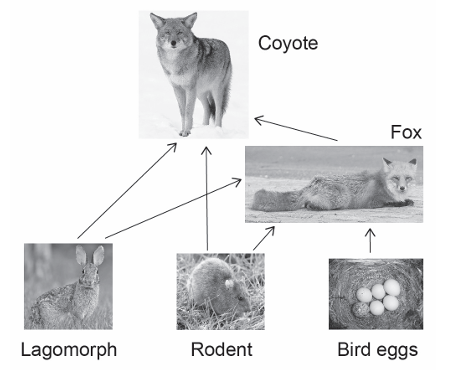
A. Decrease because there are fewer predators
B. Increase because there are fewer foxes to eat them
C. Decrease because there are more rodents for foxes to eat
D. Increase because, although there are more foxes, there are also more rodents
Easy
Mark as Complete
Mark Scheme
Question 4
Which action is part of the rewilding of ecosystems?
A. Applying fertilizer
B. Removal of apex predators
C. Reintroduction of keystone species
D. Restricting size for easier management
Easy
Mark as Complete
Mark Scheme
Question 5
A simple sealed terrestrial mesocosm was set up to demonstrate that natural ecosystems can be sustainable over long periods of time.
What indicates that the mesocosm is still sustainable after several months?
A. Wastes are constantly recycled.
B. The diversity of living organisms increases.
C. Energy is conserved.
D. The mass of carbon increases.
Easy
Mark as Complete
Mark Scheme
Question 6
What directly causes oxygen levels to drop during eutrophication in aquatic ecosystems?
A. Increased photosynthesis by aquatic plants
B. Enhanced respiration by fish
C. More decomposition of organic matter by bacteria
D. Lower levels of nitrogen in the water
Easy
Mark as Complete
Mark Scheme
Question 7
Explain the consequences of plastic pollution in marine environments. [4]
Medium
Mark as Complete
Mark Scheme
Question 8
State how species diversity usually changes during primary succession. [2]
Medium
Mark as Complete
Mark Scheme
Question 9
Explain the movement of energy and inorganic nutrients in an ecosystem. [7]
Hard
Mark as Complete
Mark Scheme
Question 10
Explain how the loss of a keystone species affects an ecosystem. [2]
Medium
Mark as Complete
Mark Scheme
Question 1
Which is not essential in a viable mesocosm?
A. Light source
B. Autotroph
C. Saprotroph
D. Herbivore
Answer: D
A. Incorrect: Light provides the energy that drives photosynthesis in autotrophs, allowing them to produce glucose and oxygen from carbon dioxide and water. Without light, autotrophs cannot produce food, leading to energy depletion and system collapse. Thus, a light source is vital for maintaining life and energy flow in the mesocosm.
B. Incorrect: Autotrophs, such as plants or algae, are primary producers that convert light energy into chemical energy. They form the base of the food web and supply energy for all other organisms. Without autotrophs, no organic matter or oxygen would be available for respiration, making the mesocosm unsustainable.
C. Incorrect: Saprotrophs (like bacteria and fungi) break down dead organisms and waste, returning essential minerals such as nitrates and phosphates to the environment. This decomposition ensures that autotrophs can reuse these nutrients for new growth. Without saprotrophs, nutrients would remain locked in dead material, disrupting the nutrient cycle and halting ecosystem function.
D. Correct: Herbivores are not essential to keep the system viable. Herbivores are consumers that feed on autotrophs (plants or algae). While they play a role in natural food webs, a mesocosm can still function without them, as long as energy flow (from light to autotrophs) and nutrient cycling (by saprotrophs) continue. Without herbivores, energy transfer between trophic levels is limited, but the basic ecosystem processes (photosynthesis, respiration, and decomposition) can still occur and remain balanced.
Question 2
What is exchanged between a sealed mesocosm and the surrounding external environment?
A. Energy
B. Water
C. Air
D. Nothing can pass
Answer: A
A. Correct: In a sealed mesocosm, all matter (such as water, air, and nutrients) is enclosed within the system and cannot enter or leave. However, energy - usually in the form of light and heat - can still pass through the container’s walls. The light energy from an external source (such as the Sun or artificial lamps) enters the mesocosm and is absorbed by autotrophs (like algae or plants) for photosynthesis, producing organic molecules and oxygen. Some of this energy is later released as heat through respiration and radiates back into the environment. Thus, the exchange of energy (light in, heat out) allows the mesocosm to function as a self-sustaining system without any need for external input of matter. Therefore, energy is the only thing exchanged between a sealed mesocosm and its surroundings.
B. Incorrect: In a sealed mesocosm, water is recycled internally through evaporation, condensation, and precipitation (a mini water cycle). Since the container is sealed, no water enters or leaves the system. Therefore, water is not exchanged with the external environment.
C. Incorrect: Air (a mixture of gases like `O₂`, `CO₂`, and `N₂`) is trapped inside the mesocosm when it is sealed. Inside the system, gases are cycled through photosynthesis and respiration, but none escape or enter. Hence, air is not exchanged with the surroundings.
D. Incorrect: This is incorrect because, although matter cannot pass, energy does. Light and heat can move through the transparent walls of the mesocosm, so it is not completely isolated from the environment.
Question 3
Humans have persecuted predators such as coyotes (Canis latrans), causing severe reduction in the number of large carnivores throughout the world. The diagram represents part of a food web in Texas, USA.
A. Decrease because there are fewer predators
B. Increase because there are fewer foxes to eat them
C. Decrease because there are more rodents for foxes to eat
D. Increase because, although there are more foxes, there are also more rodents
Answer: D
A. Incorrect: This is incorrect, because the number of predators (coyotes) actually decreases, not increases. Fewer predators usually lead to higher, not lower, prey populations.
B. Incorrect: This is incorrect, because when coyotes decline, fox numbers rise, not fall. Coyotes normally control fox populations through competition or direct predation. So, there would be more foxes, not fewer, making this option wrong.
C. Incorrect: This is incorrect, because although foxes eat rodents, the increase in rodents does not cause a decrease in other prey (like lagomorphs). The abundance of rodents doesn’t reduce their own numbers - instead, their population tends to increase due to fewer top predators (coyotes).
D. Correct: The removal of coyotes, the top predators, disrupts the food chain balance. With fewer coyotes, fox populations increase since there is less predation on them. At the same time, rodent numbers also rise because coyotes no longer hunt them directly. Although the increased number of foxes feeds on some rodents, the total rodent population still increases overall because the reduction in coyote predation has a greater effect. Thus, both foxes and rodents increase, which makes this option correct.
Question 4
Which action is part of the rewilding of ecosystems?
A. Applying fertilizer
B. Removal of apex predators
C. Reintroduction of keystone species
D. Restricting size for easier management
Answer: C
A. Incorrect: Fertilizers are a human intervention that artificially alters nutrient levels. Rewilding focuses on natural ecological processes, not artificial inputs. Fertilizing disrupts natural nutrient cycles instead of restoring them.
B. Incorrect: Rewilding usually does the opposite - it reintroduces apex predators to maintain balance in the ecosystem. Removing them causes overpopulation of prey and loss of biodiversity.
C. Correct: Rewilding aims to restore natural ecosystems and ecological balance by bringing back keystone species - organisms that have a major impact on their environment (e.g., wolves, beavers). Their return helps re-establish natural food webs, control populations, and improve biodiversity. For example, reintroducing wolves to Yellowstone National Park restored vegetation and stabilized prey populations.
D. Incorrect: Rewilding promotes large, self-sustaining ecosystems with minimal human control. Restricting size and managing closely go against the goal of allowing natural processes to occur freely.
Question 5
A simple sealed terrestrial mesocosm was set up to demonstrate that natural ecosystems can be sustainable over long periods of time.
What indicates that the mesocosm is still sustainable after several months?
A. Wastes are constantly recycled.
B. The diversity of living organisms increases.
C. Energy is conserved.
D. The mass of carbon increases.
Answer: A
A. Correct: A sustainable mesocosm can maintain life over time because wastes and nutrients are continuously recycled through natural processes. Decomposers (such as bacteria and fungi) break down dead organic matter and waste products into simpler substances like carbon dioxide, water, and mineral ions, which plants can reuse. This closed nutrient cycle keeps the system balanced and prevents the accumulation of harmful waste, showing that the mesocosm is functioning sustainably.
B. Incorrect: An increase in diversity is not necessary for sustainability. In a sealed mesocosm, the number of species usually remains stable or may even decrease slightly due to limited space and resources. Sustainability depends on stability and recycling, not continuous growth in diversity.
C. Incorrect: Energy cannot be conserved in the biological sense within the system. It must flow through - usually entering as light energy and leaving as heat. What makes the system sustainable is the recycling of materials, not the conservation of energy.
D. Incorrect: In a balanced, sustainable system, the total mass of carbon remains constant because carbon cycles between organisms and the environment through photosynthesis and respiration. An increase in carbon mass would suggest an imbalance, not sustainability.
Question 6
What directly causes oxygen levels to drop during eutrophication in aquatic ecosystems?
A. Increased photosynthesis by aquatic plants
B. Enhanced respiration by fish
C. More decomposition of organic matter by bacteria
D. Lower levels of nitrogen in the water
Answer: C
A. Incorrect: Photosynthesis by aquatic plants produces oxygen, not depletes it. Although algal blooms may initially increase oxygen during the day, the oxygen levels drop sharply at night and especially when algae die and decompose - not because of photosynthesis itself.
B. Incorrect: Fish do use oxygen for respiration, but their oxygen consumption is minor compared to bacterial decomposition during eutrophication. The main oxygen depletion results from bacteria, not animals.
C. Correct: During eutrophication, excess nutrients (mainly nitrates and phosphates) from fertilizers cause rapid growth of algae on the water surface, forming algal blooms. When these algae die, bacteria decompose the large amount of dead organic matter. This decomposition process requires oxygen (aerobic respiration), which leads to a significant drop in dissolved oxygen levels in the water. Low oxygen levels can cause fish and other aquatic organisms to suffocate, disrupting the entire ecosystem.
D. Incorrect: Eutrophication occurs due to high, not low, nitrogen levels. A reduction in nitrogen would actually decrease algal growth and thus reduce oxygen depletion. Therefore, low nitrogen is not the cause of oxygen drop - it would have the opposite effect.
Question 7
Explain the consequences of plastic pollution in marine environments. [4]
Any four of the following:
a. animals may get entangled in plastic and cannot breathe/swim;
b. macroplastics/plastics can be ingested as food OR used to feed chicks;
c. which may block their gut/cause death;
d. macroplastics broken down to microplastics OR (micro)plastics may release toxic chemicals;
e. DDT/pesticides/heavy metals;
f. microplastics/toxic chemicals may accumulate in tissues/bioaccumulate;
g. microplastics/toxic chemicals build up along food chain/in higher trophic levels/biomagnification;
h. plastics persist for a long time in the environment;
Sample answer:
Plastic pollution in marine environments has severe and long-lasting consequences. Large pieces of plastic (macroplastics) can entangle marine animals, such as turtles, fish, or seabirds, preventing them from swimming or surfacing to breathe, which often leads to injury or death [1]. Many marine organisms also mistake plastics for food or use them to feed their chicks, leading to gut blockage or starvation because the plastic cannot be digested [2]. Over time, macroplastics break down into microplastics, which are tiny particles that can release toxic chemicals such as DDT, pesticides, or heavy metals into the water [2]. These microplastics and toxins accumulate in the tissues of marine organisms (bioaccumulation) and increase in concentration along the food chain through biomagnification, ultimately affecting top predators - including humans who consume seafood [2]. Furthermore, plastics are highly persistent and remain in the marine environment for decades or centuries, making their impacts long-term and difficult to reverse [1].
Question 8
State how species diversity usually changes during primary succession. [2]
Any two of the following:
a. pioneer community/early stages has low diversity;
b. as the community develops the diversity will increase;
c. competitor community/intermediary stage has higher diversity;
d. climax community/late stages has highest diversity;
Sample answer:
During primary succession, species diversity is initially low in the pioneer community [1], then gradually increases as the ecosystem develops [1]. In the intermediate stages, diversity becomes higher [1], and by the climax community, species diversity reaches its maximum level and remains relatively stable [1].
Question 9
Explain the movement of energy and inorganic nutrients in an ecosystem. [7]
Any seven of the following:
a. autotrophs/producers/plants obtain inorganic nutrients from the «abiotic» environment;
b. energy provided «mainly» by sunlight;
c. light energy converted «to chemical energy» through photosynthesis;
d. photosynthesis/producers/autotrophs convert inorganic carbon/carbon dioxide and water into carbon/organic compounds;
e. «these» carbon compounds/foods contain/are a source of «useable» energy «for life»;
f. carbon compounds/energy are transferred along food chains when eaten by consumers/heterotrophs;
g. respiration returns carbon «dioxide» to the environment;
h. respiration releases stored/chemical energy as ATP/heat;
i. energy/ATP is used to carry out life functions/synthesis/growth/movement;
j. energy is lost/not recycled;
k. nutrients are recycled / example of recycled nutrient e.g. carbon;
l. decomposers recycle minerals/inorganic nutrients;
Sample answer:
Energy in an ecosystem flows in one direction, while inorganic nutrients are continuously recycled. Autotrophs, such as plants, obtain inorganic nutrients like carbon dioxide, water, and minerals from the abiotic environment [1]. Using sunlight as the main energy source [1], they convert light energy into chemical energy through photosynthesis [1], producing organic carbon compounds that serve as food for other organisms [1]. This stored energy is transferred along food chains when consumers eat producers and other consumers [1]. Through respiration, organisms release chemical energy as ATP to perform life processes such as growth [1], synthesis, and movement, while some energy is lost as heat and cannot be recycled [1]. In contrast, nutrients such as carbon and nitrogen are recycled [1] - decomposers break down dead organic matter and release inorganic nutrients back into the environment [1], allowing autotrophs to reuse them and maintain ecosystem sustainability.
Question 10
Explain how the loss of a keystone species affects an ecosystem. [2]
Any two of the following:
a. keystone species have a disproportionate/significant/high/large effect on the structure of an ecosystem / OWTTE;
b. loss of biodiversity/diversity of species will occur;
c. change of population size/numbers of other species may occur;
d. change/disruption in food webs/chains would occur;
e. example of loss and its effect;
Sample answer:
A keystone species has a disproportionately large effect on the structure and stability of an ecosystem compared with its abundance [1]. Its presence maintains the balance between species and the organization of the community. If the keystone species is lost [1], there will be a decline in biodiversity, because other species that depended on it for food, shelter, or regulation may also disappear. The population sizes of other species may increase or decrease dramatically [1]. For example, prey species may overpopulate without a predator keystone species, or competitors may dominate after the loss of a key herbivore. This leads to a disruption of food chains [1], causing instability in energy flow and nutrient cycling within the ecosystem. For example, if sea otters are removed from a kelp forest ecosystem, sea urchin populations increase uncontrollably, overgrazing kelp and destroying kelp forests [1]. This reduces habitat and food sources for many other organisms, leading to a collapse in biodiversity.
Question 1
Which is not essential in a viable mesocosm?
A. Light source
B. Autotroph
C. Saprotroph
D. Herbivore
Question 2
What is exchanged between a sealed mesocosm and the surrounding external environment?
A. Energy
B. Water
C. Air
D. Nothing can pass
Question 3
Humans have persecuted predators such as coyotes (Canis latrans), causing severe reduction in the number of large carnivores throughout the world. The diagram represents part of a food web in Texas, USA.
A. Decrease because there are fewer predators
B. Increase because there are fewer foxes to eat them
C. Decrease because there are more rodents for foxes to eat
D. Increase because, although there are more foxes, there are also more rodents
Question 4
Which action is part of the rewilding of ecosystems?
A. Applying fertilizer
B. Removal of apex predators
C. Reintroduction of keystone species
D. Restricting size for easier management
Question 5
A simple sealed terrestrial mesocosm was set up to demonstrate that natural ecosystems can be sustainable over long periods of time.
What indicates that the mesocosm is still sustainable after several months?
A. Wastes are constantly recycled.
B. The diversity of living organisms increases.
C. Energy is conserved.
D. The mass of carbon increases.
Question 6
What directly causes oxygen levels to drop during eutrophication in aquatic ecosystems?
A. Increased photosynthesis by aquatic plants
B. Enhanced respiration by fish
C. More decomposition of organic matter by bacteria
D. Lower levels of nitrogen in the water
Question 7
Explain the consequences of plastic pollution in marine environments. [4]
Question 8
State how species diversity usually changes during primary succession. [2]
Question 9
Explain the movement of energy and inorganic nutrients in an ecosystem. [7]
Question 10
Explain how the loss of a keystone species affects an ecosystem. [2]

